

The Canmaker Summit 2023 – Scotland
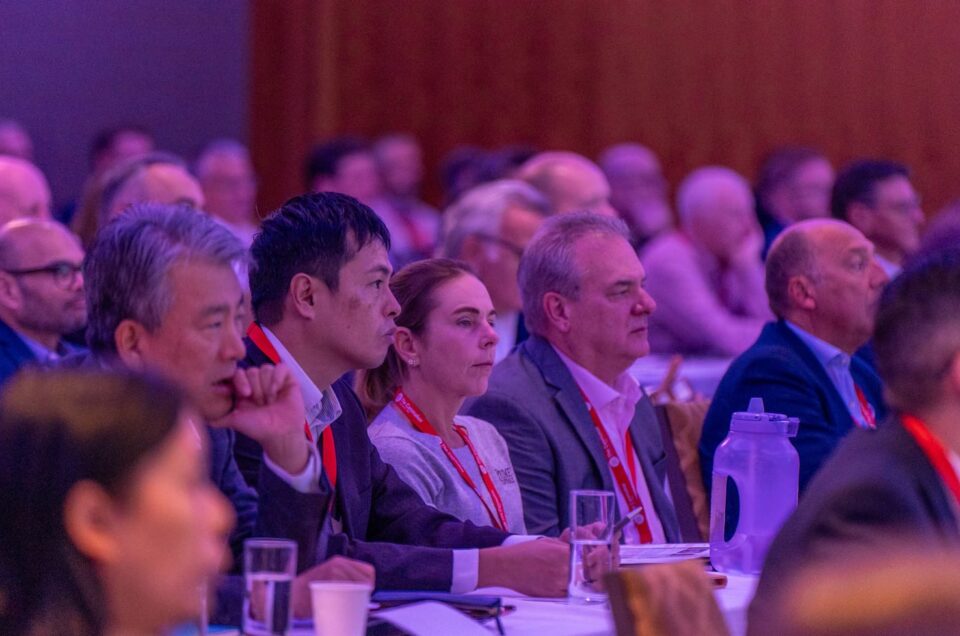
Listening to younger consumers, adopting open innovation, communicating sustainability, and embracing the fourth industrial revolution were some of the ideas exchanged at The Canmaker Summit.
Nisa Ali reports
Delegates at the Canmaker Summit commented on the “openness” of companies and willingness to share ideas and strategies over the two-day conference at the Sheraton Hotel in Edinburgh, Scotland.
Among the warmly-welcomed themes were the need for canmakers to be more consumer-focused, as well as the presentations on technology, communications, and sustainability from Roeslein & Associates,
Trivium, and Ball Beverage Packaging.
American Canning, Eviosys and Meadow all set out compelling arguments for why canmakers needed to consider not just their customers, but the end consumer.
David Racino, co-founder and chief executive of American Canning, said his company had grown by doing just that, saying that by the mid-2030s “Gen Zs and Millennials will be two-thirds of the population – why that’s relevant is because those younger demographics behave very differently as consumers” compared with previous generations.
He warned: “We have got to start paying attention to what they are doing, how they buy, what their preferences are, or we’re going to be in trouble in the next 10 years in this industry.”
Their preferences include a wider variety of flavours, convenience, such as direct-to-consumer shipping, and sustainability.
He added that alcohol consumption has been declining in the US while demand for beverages based on health and wellness, plant-based and lower-sugar products have been growing.
He said: “The way we look at this in American Canning is how do we create accessibility in cans for all producers, and how do we provide cans that are capable of holding products that were previously thought incompatible?”
His answers are to offer smaller MOQs, provide a fast-responding e-commerce site and “do a lot of R&D and testing”. He said American Canning also decided to “build the first aTULC (Aluminium Toyo Ultimate Can) line in the United States that really increases the speed to market, reduces the liability of the beverage producers and encourages them to innovate”.
He said the technology, developed by Japanese company Toyo Seikan 21 years ago, addressed these issues in the market because its pre-coated aluminium enables “more shelf life basically, better flavour for water and low corrosion”.
Open innovation
Winners of the Sustainability Award and the Delegates’ Choice Award in the Canmaker of the Year Awards, Meadow, were represented by co-founders Victor Ljungberg and Nick Paget, who described how they developed packaging to address the waste crisis by engaging with consumers at every stage of the development process.
Meadow focused on the personal care industry which, according to chief executive Ljungberg, generates 150 billion units of mostly plastic packaging and therefore huge amounts of waste.
He told delegates: “To have a chance against the massive linear packaging industry, we knew that we needed to develop it very fast, and to do that we decided to adopt an open innovation philosophy.”
One of the first ideas was to think of the aluminium can as a cartridge, and they partnered with US-based easy open end pioneers DRT.
Chief innovation officer Paget said: “We wanted it to look like a can, but not a drink. We had these design principles: use what is already here, be convenient and inclusive, provide a great user experience, and do more with less.”
Convinced that a twisting motion was a good approach, Meadow designed the daisy top, a distinctive corrugated seam. Paget explained: “It’s a secondary operation after the double seam.” He said the distinctive shape made it clear to sighted and non-sighted users that it isn’t a drink.
The end is a modified CDL 202e beverage end, in line with their design philosophy to use what already exists.
Ljungberg added: “It has been tested with multiple families in the UK. And after three weeks’ usage, data has shown that consumers love it, and they rate the system much higher than existing alternatives on the market, specifically focusing on the core design attributes of sustainability, premiumness and convenience.
“In quantitative data with known brands, consumers said it was very relevant, unique and that it was trustworthy. Data also indicates that consumers might like it so much, so brands that actually shift to this solution would gain in volume, increase market share.”
He urged the canmaking industry to consider open innovation and a more consumer-focused approach to “take the aluminium can beyond beverage and become the circular packaging standard”.
Call to action
Asking the question of why metal packaging, with its excellent sustainability and recycling credentials, is not the top choice for consumers and brands, Laetitia Durafour, marketing and communication director at Eviosys Packaging, said there were no easy answers.
However, she encouraged canmakers to take advantage of the current drive against plastic waste by focusing on key communication strategies, saying: “We should be more bullish about the waste of plastics and alternatives especially to counteract the misinformation and misconceptions that we
see everywhere.”
In a call to action, she said: “It’s time to be more vocal, we need to collaborate with partners and customers to tackle greenwashing. It’s an opportunity to get to the market with a clear message. We find ourselves at a critical juncture. It is imperative that we seize this moment and unify our message to champion metal packaging as the ultimate solution.”
Canmakers, fillers and brands could look to social media to spread their message globally, she suggested, to counteract “greenwashing”.
Eviosys was also supportive of European Commission attempts to tackle greenwashing, after it found that many environmental claims by some commercial interests were either misleading, vague or unfounded.
Durafour added: “We face an uphill battle in shifting perceptions and driving widespread adoption. Simply presenting facts and figures is not enough. We should instead provide consumers and customers … with tangible solutions aligned with their concerns. The ultimate aim is to make metal packaging the
unequivocal choice and the first choice for brands and consumers.”
Echoing those concerns, Jenny Wassenaar, chief sustainability officer and senior vice-president of global research and development at Trivium, showed delegates in an interactive presentation how public
perceptions were being skewed, with many people overestimating how much plastic and glass was recycled and underestimating metal recycling.
She said: “It’s not really a game, it’s a serious business”, urging delegates to start a discussion on what it can do to communicate the infinite recyclability of metal, and not to hide it “on the back of a can”.
“When we talk about metal recycling, with a fantastic logo, we put it somewhere on the back of a can and if you’re lucky you find it, but that’s not where I’m looking when I’m shopping,” she added.
“We have to better communicate our sustainability credentials.”
Clear pathway
Ball Beverage Packaging set out a “clear” pathway to net zero in its Climate Transition Plan, according to Dr Mandy Glew, vice-president commercial EMEA and Asia.
She said: “We have said we want to get there by 2040, we have a plan that definitely gets us there by 2050, but we want to raise the bar ourselves and we aspire towards 2040 and that’s what we’re going to work towards.”
Her colleague, Jag Bains, senior commercial director Europe, UK and SEE, talking about what Ball is doing to promote aluminium, told delegates about an energy drink launched with India cricket star Virat Kohli, who has 264 million social media followers: “So when this goes out, 264 million sets of eyeballs are looking at this brand”.
She added that Ball has also partnered with Kroenke stadiums to have a recycling message around American football fields in the US and at soccer giant Arsenal in the UK.
Glew said: “We know what we want to achieve. Ultimately, we want to do the right thing and it’s our customers who absolutely expect this.”
She described Ball’s new plants in the UK and Czech Republic, saying: “Those are absolutely state of the art. They are fabulous facilities. They are the standard that we will hold the rest of our plants against, while we will continue to evolve our existing plants.”
Fast forward
Looking to the future, JC Harrison, vice-president of products and operations at Roeslein & Associates, said the fourth industrial revolution was already here and urged delegates to “completely change the
way we think and operate”.
“Let’s be honest, we love what we do, and we don’t like to change, but we’re going to have to change”.
Challenging the delegates, Harrison said preparing for the future starts with a digital strategy for “zero unplanned downtime”.
He argued: “That seems impossible, but I beg to differ. If you flew on an airplane with a Rolls-Royce engine, I can guarantee that you expect that engine to have zero unplanned downtime.
“The same concepts Rolls-Royce has been using, we can use, with all the high analytical power that exists, we can predict when we need to do maintenance on machines that make them run better.”
He said: “We need to start spending money on better software, on better technologies. The software that you’re investing in needs to be cohesive.”
Digital transformation
Canmakers needed innovation teams, with younger people generating ideas, and a connected floor, he pressed. “We’ve had connected plant floors for a long time, but we’ve stopped short of taking it to the next level, and that’s what we need to transform.”
Data management was also essential, with a computerised maintenance system that is able to make decisions. AI robots picking up scrap at plants could be used “to make a more efficient plant and lower
our waste”.
Operator support could be provided either by calling up videos from the original equipment manufacturer (OEM), or by putting on a VR headset linked to the OEM, who can see what the operator sees and talk the operator through the steps needed.
“It’s an efficient way to work,” he added. Canmakers needed to rethink training by considering augmented reality training that was already on show at Metpack in 2017 at the CarnaudMetalbox
Engineering booth. “We need to change the way our training rooms work. We’ve got the technology.”
And he pointed to the concept of the ‘digital twin’, which could be used to process real-time analytics for decision-making. “How a digital twin differs from a can line simulation is a digital twin takes actual data from an operation and feeds it into the computer to make the next decision.”
He said: “This is how we get it better and more optimised.” Safety pays In a time of volatility, JehanZeb Noor, president of Europe, Africa and Asia division of Trivium, said it is worth focusing on the things companies could control.
Trivium, one of biggest canmakers in Europe, “doubled down on safety” which became a catalyst for “change and improvement” in the company.
He said as a result of the reportable incident rate falling from 1.6 to 0.9, increasing flexibility, empowering local managers to manage, and introducing employee support offering mentorship and a well-being programme, the “attrition rate” at the company was “much lower than our peers”.
He revealed: “Our workforce is really committed to working through this crisis, and some of our operational metrics, like scrap and labour efficiency, are the highest they’ve ever been for the last 15–20 years, and very little of that has to do with capital expenditure.”